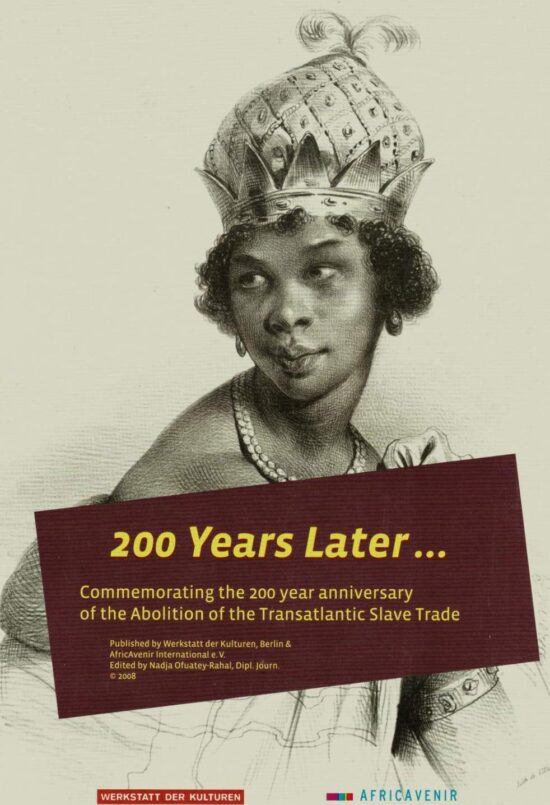
200 Years Later … Commemorating the 200 year anniversary of the Abolition of the Transatlantic Slave Trade
This catalogue was published on the occasion of the Event Series “200 Years Later…”, commemorating the 200 year anniversary of the official Abolition of the Maafa (Transatlantic Slave Trade), Berlin, 23-30.11.2008. During the opening ceremony of the event, During the Opening Ceremony of the Festival "200 Years Later..." the President of UNESCO's Executive Council, Ambassador Joseph Olabiyi Babalola Yai awarded the organizers - AfricAvenir International e.V. and Werkstatt der Kulturen - with the Toussaint Louverture Medal, which "celebrates contribution to the struggle against domination, racism and intolerance".
Order Information:
ISBN: 978-3-9812733-0-4
138 pages, full 4-colour print with 25 portraits
15€ + Packaging and Shipping (Germany: + 2,50€; Europe: + 6,00€)
You can order by Email: info(at)africavenir.org or via Fax: +49 (0)3212-1258815
At the centre of this publication stand the celebration of the much neglected and still widely unknown manifold strategies of resistance of African people / people of African descent against one of the greatest atrocities in the history of mankind and the cultural and artistic practices they developed on the basis of this resilience.
The publication on hand features portraits of some of the protagonists of this resistance, a specifically researched resistance timeline, as well as essays by eminent scholars such as Louise Marie Diop-Maes, Silviane A. Diouf, David Richardson, Joseph Olabiyi Babalola Yai, Howard Dodson, Horace Campbell, Rosa Amelia Plumelle-Uribe and others.
Table of Contents
- Philippa Ebene & Eric van Grasdorff: Preface
- Nadja Ofuatey-Rahal: Preface
- Louise Marie Diop-Maes: A Continent emptied – The truth about what slavery did to Africa
- Rosa Amelia Plumelle-Uribe: The Transatlantic Slave Trade, Slavery and Resistance
- Sylviane A. Diouf: African Resistance to the Transatlantic Slave Trade
- David Richardson: The Middle Passage
- Loren Schweninger: The Slave Trade: Resistance Strategies, Revolts, and Conspiracies in the United States
- Verene A. Shepherd: “Freedom Mus’ Come One Day”: Women & the Fight Against Slavery in the Caribbean
- Joseph Y. Olabiyi Babalola: Survivals and Dynamism of African Cultures in the Americas
- Howard Dodson: African American Culture and American Culture
- Yolande Behanzin-Joseph-Noël: African Survivals in the Secular Popular Culture of the Americas
- Kazadi wa Mukuna: Resilience of African Musical Elements and the Effect of Linguistic Styntax on Rhythmic Organization in Diaspora
- Guérin C. Montilus: African Religions in the Americas: A Structural Analysis
- Horace Campbell: Reparations and Reconstruction – Lessons from How Europe Underdeveloped Africa
- Nadja Ofuatey-Rahal: Epilogue from the editor
- Paulette Reed-Anderson: Serving the King and the Kingdom: Africans and Prussian Law in the 18th Century
- Timeline: Resistance against the Transatlantic Slave Trade and Slavery
- Bibiography
“Despite the most sophisticated strategies to destroy cultural identity, despite repeated ethnic cleansing and inhuman working conditions, despite sexual exploitation and the disintegration of their social and economic systems, Africans were able to ensure the survival of the key parts of their original cultures, due to the initiatives that they were able to take or to the negotiated spaces that they were able to extract from – or impose on – their ‘masters’. They also assimilated some of the practices of the other cultures with which they came into contact, interpreting and re-creating them as they did so.” Joseph Olabiyi Babalola Yai (President unesco Executive Board)